Forgive the delay. Nothing much to report for the moment. Here's an article from the New York Times; it's stuff like this that still makes me feel weird about being back in America. In all of my 27 years, I've never had a pedicure. I clearly have had a misspent childhood.
http://www.nytimes.com/2008/02/28/fashion/28Skin.html
Never Too Young for That First Pedicure
By CAMILLE SWEENEY
Published: February 28, 2008
ONE recent rainy afternoon, Eleanor LaFauci, 7, sat with her feet in open-toed foam slippers, admiring her toenails, freshly painted watermelon pink.
“Look, we’re reading an adult magazine,” Eleanor told her mother, gleefully waving a copy of People with a desultory-looking Britney Spears on its cover.
Eleanor was in the bubble-gum-colored pedicure lounge of Dashing Diva, the Upper West Side franchise of the international nail spa, with her 3 ½-year-old sister and a half-dozen or so friends. The girls were celebrating her birthday with mani’s, pedi’s and mini-makeovers with light makeup and body art — glitter-applied stars, lightning bolts and, of course, hearts.
Eleanor’s mother, Anne O’Brien, stood watching and shrugged. “What can I say?” said Ms. O’Brien, whose husband suggested the party. “She’s a girly girl. I’m not quite sure how it happened. I didn’t get my first manicure until I was 25.”
Traditionally, young girls have played with unattended M.A.C. eye shadow or Chanel foundation, hoping to capture a whiff of sophistication. In the recent past, young girls have also tagged along on beauty expeditions by their mothers and teenage sisters.
But today, cosmetic companies and retailers increasingly aim their sophisticated products and service packages squarely at 6- to 9-year-olds, who are being transformed into savvy beauty consumers before they’re out of elementary school.
“The starter market has definitely grown, I think, due to a number of cultural influences,” said Samantha Skey, the senior vice president for strategic marketing of Alloy Media and Marketing.
Reality programming like “America’s Next Top Model” often hinges on the segment devoted to a hair and beauty transformation for the contestants, Ms. Skey said. On social networking sites like Facebook and MySpace, members’ intense self-focus and their attention to how they present themselves also affect 6- to 9-year-olds, even though technically, they aren’t allowed to set up profiles on the sites, she added. “We live in a culture of insta-celebrity,” Ms. Skey said. “Our little girls now grow up thinking they need to be ready for their close-up, lest the paparazzi arrive.”
Sweet & Sassy, a salon and party destination based in Texas for girls 5 to 11, includes pink limo service as a party add-on, which starts at $150 a ride. And Dashing Diva franchises often offer virgin Cosmos in martini glasses along with their extra-virgin nail polish, free of a group of chemicals called phthalates, for a round of services for a birthday girl and her friends.
At Club Libby Lu, a mall-based chain and the most mainstream of the primping party outlets, girls of any age can mix their own lip gloss and live out their pop idol fantasies. Last year, the chain did about a million makeovers in its 90 stores nationwide, said Ari Goldsmith, the director of advertising and marketing.
Many of those were Hannah Montana makeovers, which entail donning blond wigs, makeup and concert costumes like the ones the girls’ idol wears. Mom and dad capturing them on the camcorder belting tunes is optional.
Dozens of results can be seen on YouTube, including one zealous poster’s series of “Rebecca as Hannah Montana.”
Brides and bachelorettes have long thrived on beauty services done en masse. But now primping parties are even popular for first graders.
Tracy Bloom Schwartz, an event planner at Creative Parties in Bethesda, Md., said that she ordered beauty-theme stock invitations a couple of years ago. “I figured we’d sell them for bridal and bachelorette-type of events,” she said.
“But now the parents of little girls — easily 6 years old — use these cards as invitations for their daughters’ birthday primping parties. And, the slightly older girls, say, 8 and 9, use them for makeover slumber parties,” she said. “Sometimes I want to ask, ‘makeover what?’ ”
In a study last year, 55 percent of 6- to 9-year-old girls said they used lip gloss or lipstick, and nearly two-thirds said they used nail polish, according to Experian, a market research company based in New York. In 2003, 49 percent of 6- to 9-year-old girls said they used lip gloss or lipstick.
Youth market analysts say this is part of a trend called KGOY, “kids getting older younger,” and cultural observers describe a tandem phenomenon, more-indulgent parents.
It’s a point that vexes Rosalind Wiseman, the author of “Queen Bees & Wannabes” (Three Rivers Press, 2003). “Mothers and fathers do really crazy things with the best of intentions,” she said. “I don’t care how it’s couched, if you’re permitting this with your daughter, you are hyper-sexualizing her. It’s one thing to have them play around with makeup at home within the bubble of the family. But once it shifts to another context, you are taking away the play and creating a consumer, and frankly, you run the risk of having one more person who feels she’s not good enough if she’s not buying the stuff.”
A generation ago, girls had fewer products to choose from. Now, they have nail art; fragrance roll-ons; and all manner of glitter for face, neck, shoulders and hair marketed to them. That’s in addition to staples like lip balms, lip glosses and nail lacquers.
These products are moderately priced so that grandparents and parents can treat. Or so the very young can afford them with nothing more than change from the sofa, or their meager weekly allowance.
“Packaging is key,” said Ricardo Cruz, the marketing and licensing manager of the youth division of Markwins International, a company that licenses and manufactures a Bratz line of cosmetic gift sets as well as ACT, the company’s own brand. Because it’s makeup for little girls, Mr. Cruz said: “We’re not going to put lip plumper in there. It’s just little things the girls can test out, try on with their friends.”
With more-pressing issues of online predators, fast-food consumption and homework that needs to be done, the 10 parents interviewed for the article all said that they had allowed their daughters to attend a primping party.
“Of course, it depends on your environment, but here, I’ve even heard of Girl Scout troops doing this kind of social beauty thing,” said Stacie Christopher, a mother of three from Chevy Chase, Md.
And yet, there is always potential for backlash.
Last summer, when Bonne Bell and Mattel announced a partnership to introduce a line of Barbie-inspired Bonne Bell beauty products for 6- to 9-year-olds at the end of this year, a modest firestorm was set off online. A debate followed on Jezebel, a celebrity and fashion blog, on how young was too young for girls to wear makeup. One commenter reduced it to a simple formula: “Lip gloss and mascara at age 12 = sure. Anything other than pink nail polish on anyone under 10 = no.”
But cosmetics for girls at any age worries Lucy Corrigan, a mother of two daughters, 8 and 11, in Hastings-on-the-Hudson, N.Y. Still, last year she allowed her younger daughter to go to two salon birthday parties for 7-year-olds. “Of course, it was alarming,” she said. “But I’d rather my girls try it and decide they don’t need all these products to be beautiful, and then do something more vital with their time and money and efforts, like write a poem or take a walk or save the world.”
Showing posts with label kids. Show all posts
Showing posts with label kids. Show all posts
Wednesday, March 05, 2008

Thursday, June 01, 2006
On Tuesday, Ariston's dad came home while I was giving Ariston his lesson. Usually, when either of the parents come home early, I cut the lesson short because Ariston is no longer interested in anything I can offer; Mom and Dad are much cooler than me.
So Ariston runs off to play with Dad and I go back to his room to tidy up. Five minutes later I hear screams to high heaven.
"Give it to me, Ariston," I hear his dad plead. Ariston just went on wailing. Then Dad comes into the room carrying the screaming, tearing, red-faced kid.
"What's wrong, Ariston?" I ask. In one fist he's got a red one-hundred yuan note. "I had some money out, he took it, and now, he won't let go of it," his father explained. "Ariston, give it back!" the father asked. Ariston would not give up the bill to save his life.
"Give it to Maile, then," Dad said, hoping I would be enough of a diversion to loosen his son's grip. Ariston gave me one look, paused, then continued screaming and crying.
One hundred yuan is about $12. It's the largest denomination of money available in China. For a kid in China, 100 yuan is easily as valuable as a hundred dollars for a kid in the States. There was precious little coming between the 20-month old Ariston and the money.
 The expression "tight-fisted Chinaman" came to mind and I burst into laughter. "He's learned early," I told his dad. "Money and the ABCs...the basics are covered," his dad said.
I went into the other room, got my things together and when I went back to say goodbye, Ariston was being fed by his nanny and the cook. He still had his fist wrapped around the red bill. I laughed again, and said "goodbye". Ariston looked up from his lunch, smiled, and in perfect English, said, "money".
So Ariston runs off to play with Dad and I go back to his room to tidy up. Five minutes later I hear screams to high heaven.
"Give it to me, Ariston," I hear his dad plead. Ariston just went on wailing. Then Dad comes into the room carrying the screaming, tearing, red-faced kid.
"What's wrong, Ariston?" I ask. In one fist he's got a red one-hundred yuan note. "I had some money out, he took it, and now, he won't let go of it," his father explained. "Ariston, give it back!" the father asked. Ariston would not give up the bill to save his life.
"Give it to Maile, then," Dad said, hoping I would be enough of a diversion to loosen his son's grip. Ariston gave me one look, paused, then continued screaming and crying.
One hundred yuan is about $12. It's the largest denomination of money available in China. For a kid in China, 100 yuan is easily as valuable as a hundred dollars for a kid in the States. There was precious little coming between the 20-month old Ariston and the money.
 The expression "tight-fisted Chinaman" came to mind and I burst into laughter. "He's learned early," I told his dad. "Money and the ABCs...the basics are covered," his dad said.
I went into the other room, got my things together and when I went back to say goodbye, Ariston was being fed by his nanny and the cook. He still had his fist wrapped around the red bill. I laughed again, and said "goodbye". Ariston looked up from his lunch, smiled, and in perfect English, said, "money".
Saturday, April 01, 2006
There is a new man in my life. I met him a couple of months ago, and now I spend time with him nearly everyday. He comes from a very good family (in fact, I think his parents are loaded), and while he doesn't talk too much, he demonstrates a quick intelligence.
Ariston is very sensitive, and there are times when he cannot control his emotions. I have learned to have patience with him. I realize that boys from good families like to have their way. But mostly, Ariston and I get along swimmingly. He's a very good looking fellow, and he drools all over for me. I must admit he is shamelessly fascinated with my breasts, which he sometimes demonstrates at the most inappropriate of times, but hey, we've all got our foibles, don't we?
This is Ariston.
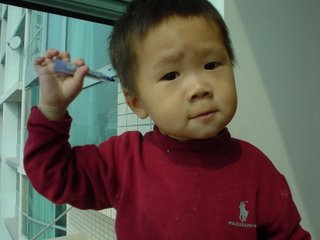
You see, he's a senstive boy.
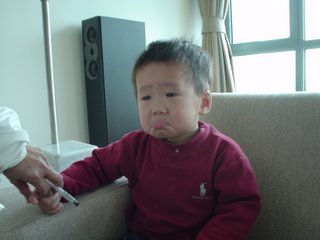
Ariston is very sensitive, and there are times when he cannot control his emotions. I have learned to have patience with him. I realize that boys from good families like to have their way. But mostly, Ariston and I get along swimmingly. He's a very good looking fellow, and he drools all over for me. I must admit he is shamelessly fascinated with my breasts, which he sometimes demonstrates at the most inappropriate of times, but hey, we've all got our foibles, don't we?
This is Ariston.
You see, he's a senstive boy.
Sunday, November 06, 2005

Friday, October 28, 2005
Discipline is the foreign teacher's greatest challenge. Different cultures and language barriers, on top of the mysterious ways of children, make knowing what to do foggy, but as anyone who has ever taught, even for a very short time, knows, discipline is essential if you are to get anything done.
In general, for the sake of my sanity, I rule my classes with an iron fist. I have found (through intimate experience) that leniency resulting from the desire to "be a friend" and "make learning fun" is the gaff of a beginner, especially in Confucian Asia, where education is serious business and social lines are quite clear. And I know, that even at my strictest, I am nowhere near the level of fascist at which most Asian (especially Chinese) teachers rule. I have never hit a kid, and I don't think I could (although I understand now why someone would), but some of the Korean teachers I work with keep long sticks on their desks.
My least favorite class is my third and fourth grade "B" class (the classes are graded "A" through "D," "D" being the near equivalent of "gifted and talented" in the States, and "A" being "you are here because you are too young for prison"). As kids, the kids in this class are alright. They're pretty cute and pretty social, but as students, but for a few exceptions, they suck. They play, draw, talk too much, or not at all, sleep and take frequent trips to the toilet and clinic. We actually get very little done in this class, as they are slow to catch on to new ideas (go ahead, blame the teacher) and I spend much of my time telling them to stop throwing, eating, sleeping, drawing, hitting, kicking and talking.
Ron sits in the back of the class. He wears glasses, is always quiet and, except for when I stand directly behind to monitor his activity, he is endlessy drawing pictures of tanks, guns and people shooting each other.
I usually get to class a few minutes early and on Monday, Ron came up to my desk as if tell me something. But, instead of saying anything, he sticks his tongue out at me then walks away with a very slight smirk. I held back the laughter. To be fair, he caught me off guard, and it was pretty funny. I was going to let it slide until Eric, another student, yells across the class "Teacher! He --points to his tongue and then to me--you?!" The little punk me the butt of the joke (and let's face it, I have a hard enough time preventing myself from making me the butt of many jokes)and because of that, just to maintain some semblance of authority, Ron had to be punished.
The bell rang and I called Ron up to the front of the class. I pointed for him to stand just next to me and he knew exactly why as he instantly got down on his knees (as Asian thing). The whole kow-tow routine makes me a bit uncomfortable, so I told him "Just stand there and don't move until I tell you." And he did. For about 43 seconds. I turned back, "Ron, stand still. Put your hands down. Look forward!" He did. For a bit. And then I corrected him again, and this carried on for about five minutes until he finally gave up and just stood there.
Class continued and Ron stood there. It was my intention to keep him there the duration of the class, or until he started looking genuinely sorry, but when the class got into their readers, the kid started wiggling. "Ron, stand still," I ordered and then, for no reason apparent, Ron started back for his desk. "Ron...!" I started when, after two feeble steps the kid's legs went out from under him. He fell off the step (my desk is on a riser), and went down head first smacking his face, hard, against the corner of another student's desk. He hit the floor with a thud then rolled onto his back, tangling up his feet in the legs of student's desk across the aisle. I dropped the book and ran. "Ron!" I yelled. By this point all of the kids were out of their seats and hovering.
"Teacher! Teacher! You --drags his finger across his neck--him!" one kid yelled! "He's not dead! I said, allowing the notion to cross my mind, "Go get another teacher!" I told one of the girls.
Ron lay there and but for tears welling up under his glasses, he didn't move. The corner of his right nostril was clearly torn and started bleeding. And then gushing. "Go to the toilet and get paper!" I told another kid. I moved the desk he had his legs caught in out of the way and I put my sweater under his head.
Kids are really tricky. It's hard to know what they're up to sometimes. A stomachache might be a stomachache, but 70 percent of the time, it's scam to get out of class, and teachers bear the burden of having to act on what we perceive to be the truth. Having relatively little experience with kids, I tend to err on the side of caution, but this can often be the wrong thing to do, too, as the kids can and will take advantage of it. So with Ron, I was caught. He was clearly hurt, but the nagging voice of reason was telling me he was camping it up for effect ever so slightly.
Fortunately, two teachers from the next door classes came to my rescue and the kids rattled away recounting the tale in Korean. "Did he hit his head?" they asked. "Really hard!" I explained. I showed them what happened. The Korean teachers fussed over Ron and I ran out for more tissue as his nose was really going. He was up off the floor when I got back and the teachers hauled him off. I apologized profusely, but they didn't seem to think anything was too serious.
Needless to say, class was difficult to resume, but I got the kids back into their chairs and we finished our reading. Class ended without further incident and I went straight to my boss to tell him what happened. Ron was in there in the teacher's room, waiting for his parents, his nose held shut with a giant strip of tape, when I came in. He refused to look at me.
"These things happen," my boss said, much to my amazement and relief, "kids are kids." My Korean co-teacher (we teach the same classes alternately), Wendy, tended to Ron. I explained the whole story to her. Apparently, they all thought he just fell - the part where he was punished for sticking out his tongue at me was neglected somehow. "I see..." she said, which made me feel worse, like I was ratting the kid out.
After school, Ron's parents came. They were an exceptionally well-groomed Korean couple and instead of being pissed and litigious, as I feared (as any American parents would be), they were very polite and grateful for our care. Wendy explained the story and on the way out, much to my astonishment, Ron's mother smacked him upside the back of his head.
I was in the clear.
So from this ordeal, lessons have been learned: Korean parents are reasonable, kids are kids and the next time someone is naughty, I'm sticking them in a chair.
EPILOGUE:
Ron missed class the next day, but came back the day after with huge swathes of gauze taped to the middle of his face. I caught him drawing again, and took away his sketch books, WITH RESISTANCE.
In general, for the sake of my sanity, I rule my classes with an iron fist. I have found (through intimate experience) that leniency resulting from the desire to "be a friend" and "make learning fun" is the gaff of a beginner, especially in Confucian Asia, where education is serious business and social lines are quite clear. And I know, that even at my strictest, I am nowhere near the level of fascist at which most Asian (especially Chinese) teachers rule. I have never hit a kid, and I don't think I could (although I understand now why someone would), but some of the Korean teachers I work with keep long sticks on their desks.
My least favorite class is my third and fourth grade "B" class (the classes are graded "A" through "D," "D" being the near equivalent of "gifted and talented" in the States, and "A" being "you are here because you are too young for prison"). As kids, the kids in this class are alright. They're pretty cute and pretty social, but as students, but for a few exceptions, they suck. They play, draw, talk too much, or not at all, sleep and take frequent trips to the toilet and clinic. We actually get very little done in this class, as they are slow to catch on to new ideas (go ahead, blame the teacher) and I spend much of my time telling them to stop throwing, eating, sleeping, drawing, hitting, kicking and talking.
Ron sits in the back of the class. He wears glasses, is always quiet and, except for when I stand directly behind to monitor his activity, he is endlessy drawing pictures of tanks, guns and people shooting each other.
I usually get to class a few minutes early and on Monday, Ron came up to my desk as if tell me something. But, instead of saying anything, he sticks his tongue out at me then walks away with a very slight smirk. I held back the laughter. To be fair, he caught me off guard, and it was pretty funny. I was going to let it slide until Eric, another student, yells across the class "Teacher! He --points to his tongue and then to me--
The bell rang and I called Ron up to the front of the class. I pointed for him to stand just next to me and he knew exactly why as he instantly got down on his knees (as Asian thing). The whole kow-tow routine makes me a bit uncomfortable, so I told him "Just stand there and don't move until I tell you." And he did. For about 43 seconds. I turned back, "Ron, stand still. Put your hands down. Look forward!" He did. For a bit. And then I corrected him again, and this carried on for about five minutes until he finally gave up and just stood there.
Class continued and Ron stood there. It was my intention to keep him there the duration of the class, or until he started looking genuinely sorry, but when the class got into their readers, the kid started wiggling. "Ron, stand still," I ordered and then, for no reason apparent, Ron started back for his desk. "Ron...!" I started when, after two feeble steps the kid's legs went out from under him. He fell off the step (my desk is on a riser), and went down head first smacking his face, hard, against the corner of another student's desk. He hit the floor with a thud then rolled onto his back, tangling up his feet in the legs of student's desk across the aisle. I dropped the book and ran. "Ron!" I yelled. By this point all of the kids were out of their seats and hovering.
"Teacher! Teacher! You --drags his finger across his neck--
Ron lay there and but for tears welling up under his glasses, he didn't move. The corner of his right nostril was clearly torn and started bleeding. And then gushing. "Go to the toilet and get paper!" I told another kid. I moved the desk he had his legs caught in out of the way and I put my sweater under his head.
Kids are really tricky. It's hard to know what they're up to sometimes. A stomachache might be a stomachache, but 70 percent of the time, it's scam to get out of class, and teachers bear the burden of having to act on what we perceive to be the truth. Having relatively little experience with kids, I tend to err on the side of caution, but this can often be the wrong thing to do, too, as the kids can and will take advantage of it. So with Ron, I was caught. He was clearly hurt, but the nagging voice of reason was telling me he was camping it up for effect ever so slightly.
Fortunately, two teachers from the next door classes came to my rescue and the kids rattled away recounting the tale in Korean. "Did he hit his head?" they asked. "Really hard!" I explained. I showed them what happened. The Korean teachers fussed over Ron and I ran out for more tissue as his nose was really going. He was up off the floor when I got back and the teachers hauled him off. I apologized profusely, but they didn't seem to think anything was too serious.
Needless to say, class was difficult to resume, but I got the kids back into their chairs and we finished our reading. Class ended without further incident and I went straight to my boss to tell him what happened. Ron was in there in the teacher's room, waiting for his parents, his nose held shut with a giant strip of tape, when I came in. He refused to look at me.
"These things happen," my boss said, much to my amazement and relief, "kids are kids." My Korean co-teacher (we teach the same classes alternately), Wendy, tended to Ron. I explained the whole story to her. Apparently, they all thought he just fell - the part where he was punished for sticking out his tongue at me was neglected somehow. "I see..." she said, which made me feel worse, like I was ratting the kid out.
After school, Ron's parents came. They were an exceptionally well-groomed Korean couple and instead of being pissed and litigious, as I feared (as any American parents would be), they were very polite and grateful for our care. Wendy explained the story and on the way out, much to my astonishment, Ron's mother smacked him upside the back of his head.
I was in the clear.
So from this ordeal, lessons have been learned: Korean parents are reasonable, kids are kids and the next time someone is naughty, I'm sticking them in a chair.
EPILOGUE:
Ron missed class the next day, but came back the day after with huge swathes of gauze taped to the middle of his face. I caught him drawing again, and took away his sketch books, WITH RESISTANCE.
Sunday, June 05, 2005
Oh we're going to a huki lau!

Children's Day was June 1. It was a big to do for the school and our department spent two weeks teaching the children songs and dances. There was supposed to be a performance competition and my boss made a huge effort to be sure that our routine was the most original and creative. Any ideas as to who came up with the Huki Lau?
The competition was cancelled in the end (we all suspect that the other departments caught wind of what we were up to and called the whole thing off), but the kids performed non-competitively.
Our kids made waves with their Aloha shirts, leis and skirts and for the most part, the parents were thrilled to see their little darlings steal the show against their uniform clad contemporaries in the other departments.
This is Lauren, one of my best third graders. Here is she doing an excellent job of hiding her protests of "Miss Cannon, can I go now?"


Becoming a Young Pioneer

In China, you'll see most Chinese school students wear a red scarf around their necks. This means that the child has attained the status of "Young Pioneer," the party equivalent of having received first communion.
Up to rather recently, children had to prove themselves fit for the honor by demonstrating their academic prowess and mastery of all things Young Pioneerness, but now, especially at my school where the children come from affluent families, all of the students receive the title.
On Children's Day, all of our first graders received the stamp of Young Pioneer and in this photograph you can see the older students bequeathing the little ones with the red scarves.
The children, of course, take all of this rather seriously. If my third and fourth graders are any indication of what's to come, I'm sure the little ones will wait almost a week before they start wrapping their scarves around their heads, their waists and sucking on the ends until they're gooey and frayed.
Tuesday, January 18, 2005
Just a quick post. I will be back in Kona on the 23rd. Things have been crazy here as our schedules are wacky due to the upcoming holiday. Here is another writing assignment from one of my fourth graders.
Untitled
By Larry, age 9
Ms. Yang is our English teacher. Her English is very good and she is very strict. Ms. Cannon is our English teacher. Her English is better than Ms. Yang's. She is very cute. [Really, he wrote this.] Sometimes Ms. Cannon is angry.
Untitled
By Larry, age 9
Ms. Yang is our English teacher. Her English is very good and she is very strict. Ms. Cannon is our English teacher. Her English is better than Ms. Yang's. She is very cute. [Really, he wrote this.] Sometimes Ms. Cannon is angry.
Wednesday, January 12, 2005
Those who know me know that I'm not a huge fan of kids. I suppose this sounds a bit strange given that I am a school teacher, but it's true. Kids are smelly, noisy, demanding, manipulative, self-centered and completely unable of getting through the day without adult attention. What this job has taught me, though is that children can also be quick to learn, genuinely good natured, creative and because they have yet to develop a solid idea of what society determines to be "right" and "wrong," they are prone to saying whatever is on their minds at the moment, and often what they say is funny.
I was walking down the hall when I heard little voices yelling "Miss Cannon! Miss Cannon!" I turned to see two girls waving at me from their line where they wait to get into class. There were really small, second graders, so I didn't know them.
I say hello. One girl pipes up, "Miss Cannon! I like you!" The other parrots the first, "I like you!" I laughed. I had no idea who these kids were.
"Why do you like me?" I asked the girls. "Huh?" They didn't understand me. "Why?" I asked again. "Huuuhhhh?" They still didn't understand. "Weishenme?" I finally asked them in Chinese. Their teacher can worry about their English.
The first girl, without thinking about it says "You is very cute!" I laughed. The second girl chimed in, "You is cute!" I laughed and told them that they were very cute and that I like them, too.
Kids also have a keen sense of character.
Monday, December 06, 2004
We do writing in fourth grade on Fridays. Writing consists of filling out a predesigned form that follows a very rigid and often very dull pattern. I don't like it, the kids don't like it, but we do it because we have to. What the students often do, probably to stay awake, is use each other's names in their stories. Some of the time it's quite innocent, but much of time what they write about each other tends to get pretty nasty. The words "poop," "stink," "ugly," "kill," "yucky" and "dead" are often used liberally. As much as I think it's funny, and in my defense it does keep them interested in their work, I end up having to limit the practice. I am the grown up after all.
Last week's exercise was especially dull, so after the kids finished it, I gave them the option of writing a form paragraph, per design, or writing anything of their choosing as long as it wasn't too nasty, or too easy, ie. "My name is Jessica. I am nine years old. I live in Beijing..."
Here is the story written by Michelle. It is the first time that my name has made it into a writing exercise. I can only guess that this means I am "getting through to them," but I'm not sure if that's a good thing or not.
A LOVE STORY
By Michelle Liu, age 9
An ant named Poop was very ugly, but he was kind too. He had no friends. He lived by himself. He wanted to marry the pretty anteater Cannon. He wanted to see her, but he was afraid that she would eat him. But he loved Cannon! At last he went to meet her. He said “Oh, my sweet, I love you. I know you will eat me, but in my life, if I can see you, even if you eat me, I will be happy!” Cannon didn’t say anything. She ate Poop. But Poop loved her until the end.
The end.
Subscribe to:
Posts (Atom)


One of my kindergarteners, Robert, wanted something in my hand and when I wouldn't give it to him, he grabbed my wrist and scratched me. I told the Korean teacher she explained to him, in the most patient of tones, that he cannot scratch people. He told him to say "sorry," but he wouldn't. He did manage, after some coaxing, to come up with "Lao shi, dui bu qi," the Chinese for "I'm sorry, Teacher."